
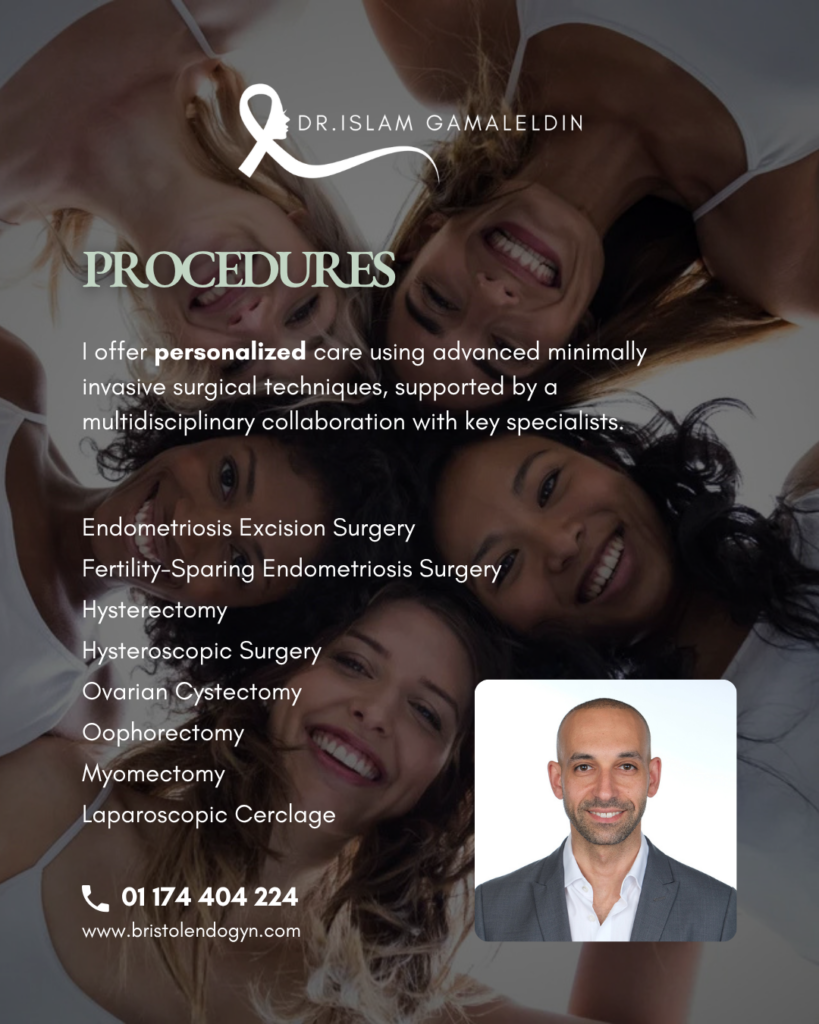
Modern gynaecological surgery procedures can treat a wide range of conditions affecting women’s health, from endometriosis and ovarian cysts to fibroids, heavy menstrual bleeding and cervical insufficiency.
Whenever clinically appropriate, minimally invasive techniques such as laparoscopy, hysteroscopy and robotic-assisted surgery can be considered. The aim is to provide effective treatment while minimising surgical trauma and supporting recovery.
At Bristol EndoGyn, each treatment plan is personalised according to the patient’s diagnosis, symptoms, fertility wishes and individual circumstances.
What Is Minimally Invasive Gynaecological Surgery?
Minimally invasive gynaecological surgery refers to procedures performed without the large abdominal incision traditionally required for open surgery.
Depending on the condition being treated, this may include:
- Laparoscopic surgery
- Robotic-assisted surgery
- Hysteroscopic surgery
Laparoscopic and robotic procedures are performed through small abdominal incisions, while hysteroscopic surgery allows certain conditions inside the uterus to be treated through the cervix without an abdominal incision.
For appropriately selected patients, minimally invasive surgery may offer advantages such as smaller incisions, shorter hospital stays and faster recovery compared with open abdominal surgery.
However, the most appropriate surgical technique depends on the individual patient and the procedure required.
Endometriosis Excision Surgery
Endometriosis occurs when tissue similar to the lining of the uterus is found elsewhere in the body.
It can cause symptoms including pelvic pain, painful periods, pain during sexual intercourse, bowel or bladder symptoms and fertility difficulties.
Endometriosis excision surgery aims to identify and surgically remove visible endometriosis while carefully protecting surrounding healthy structures where possible.
Complex endometriosis surgery may involve areas close to the bowel, bladder, ureters, ovaries and other important pelvic structures.
For this reason, advanced surgical expertise and, when necessary, multidisciplinary collaboration can be particularly important.
Fertility-Sparing Endometriosis Surgery
For patients who wish to become pregnant in the future, fertility considerations can form an important part of surgical planning.
Fertility-sparing endometriosis surgery aims to treat the disease while considering the preservation of reproductive organs and healthy ovarian tissue wherever clinically appropriate.
Several factors need to be considered, including:
- Age
- Ovarian reserve
- Previous ovarian surgery
- Location and extent of endometriosis
- Presence of ovarian endometriomas
- Previous fertility treatment
- Future pregnancy plans
There is no single surgical approach that is appropriate for every patient.
Treatment should therefore be personalised following careful assessment and discussion of reproductive goals.
Hysterectomy
A hysterectomy is an operation to remove the uterus.
It may be considered for certain gynaecological conditions when other treatments have not been effective or when hysterectomy represents the most appropriate treatment for the individual patient.
Reasons for considering a hysterectomy can include:
- Fibroids
- Adenomyosis
- Heavy menstrual bleeding
- Chronic pelvic pain in appropriately selected cases
- Other benign gynaecological conditions
Depending on the patient’s circumstances, hysterectomy may be performed laparoscopically, robotically, vaginally or through open abdominal surgery.
Importantly, hysterectomy is not automatically a treatment for every patient with endometriosis. Endometriosis can exist outside the uterus, so treatment decisions require careful individual assessment.
Hysteroscopic Surgery
Hysteroscopy allows the inside of the uterus to be examined using a thin telescope passed through the vagina and cervix.
No abdominal incision is required.
Hysteroscopic surgery may be used to investigate or treat conditions including:
- Endometrial polyps
- Some submucosal fibroids
- Abnormal uterine bleeding
- Intrauterine adhesions
- Certain abnormalities of the uterine cavity
Whether a procedure can be performed hysteroscopically depends on the location, size and nature of the condition being treated.
Ovarian Cystectomy
An ovarian cystectomy is an operation to remove a cyst from the ovary while aiming to preserve healthy ovarian tissue where possible.
Many ovarian cysts do not require surgery. Some resolve naturally or can be monitored with ultrasound.
Surgery may be considered depending on factors such as:
- Cyst size
- Ultrasound appearance
- Persistent or worsening symptoms
- Changes over time
- Menopausal status
- Individual risk factors
For patients concerned about future fertility, careful surgical planning is particularly important when operating on the ovaries.
Oophorectomy
An oophorectomy is the surgical removal of an ovary.
Removing an ovary is different from removing an ovarian cyst alone and is not necessary for every ovarian condition.
An oophorectomy may be recommended in selected circumstances when preserving the ovary is not considered appropriate or safe.
The potential hormonal and fertility implications should be discussed before surgery, particularly when removal of both ovaries is being considered.
Myomectomy for Fibroids
Fibroids are benign growths arising from the muscle of the uterus.
They can cause heavy periods, pelvic pressure, abdominal swelling, pain and, in some circumstances, fertility problems.
A myomectomy removes fibroids while preserving the uterus.
Depending on the number, size and location of the fibroids, myomectomy may be performed using:
- Hysteroscopic surgery
- Laparoscopic surgery
- Robotic-assisted surgery
- Open abdominal surgery
The most appropriate approach is determined following specialist assessment and imaging.
Laparoscopic Cerclage
Cervical insufficiency occurs when the cervix shortens or opens too early during pregnancy, potentially increasing the risk of late miscarriage or preterm birth.
A cervical cerclage is a stitch placed around the cervix to provide additional support.
Most patients requiring cerclage do not need an abdominal procedure. However, a transabdominal cerclage may be considered in selected patients, including some women for whom a vaginal cerclage has previously been unsuccessful or is technically unsuitable.
A laparoscopic approach allows an abdominal cerclage to be placed using minimally invasive surgical techniques.
Careful specialist assessment is essential to determine whether this procedure is appropriate.
What Are the Potential Benefits of Minimally Invasive Surgery?
For suitable patients, minimally invasive gynaecological surgery may offer several advantages compared with traditional open abdominal surgery.
Depending on the procedure, these may include:
- Smaller incisions
- Reduced postoperative discomfort
- Shorter hospital stay
- Earlier mobilisation
- Faster return to normal activities
- Reduced abdominal scarring
These benefits are not guaranteed, and recovery varies according to the procedure, complexity of surgery and individual patient.
The primary objective should always be safe and appropriate treatment rather than choosing a technique solely because it is minimally invasive.
Laparoscopic and Robotic Gynaecological Surgery
Both laparoscopy and robotic-assisted surgery are minimally invasive approaches.
Robotic surgery provides the surgeon with magnified three-dimensional visualisation and highly articulated instruments. These features may be useful during selected complex procedures.
However, robotic surgery is not automatically the best option for every operation.
The robotic system is a surgical tool controlled entirely by the surgeon. It does not perform the operation independently.
The decision between conventional laparoscopy, robotic-assisted surgery and another approach should be based on the patient’s condition and individual surgical requirements.
Why Personalised Surgical Planning Matters
Two patients with the same diagnosis may require very different treatment.
Before recommending surgery, several factors should be considered, including:
- Symptoms and their impact on quality of life
- Previous treatments
- Previous operations
- Imaging findings
- Age and general health
- Fertility wishes
- Personal treatment preferences
- Complexity of the condition
In some cases, surgery may not be the first or most appropriate treatment.
A specialist consultation provides an opportunity to understand the diagnosis, discuss alternatives and make an informed decision.
Specialist Gynaecological Surgery in Bristol
At Bristol EndoGyn, patients can access specialist care for endometriosis and a range of benign gynaecological conditions.
Care includes advanced minimally invasive surgical techniques, with laparoscopic, hysteroscopic and robotic-assisted approaches considered where clinically appropriate.
For complex conditions, multidisciplinary collaboration with other specialists can form an important part of treatment planning.
The objective is simple: to provide the right treatment for the individual patient, using an evidence-based and personalised approach.
To arrange a specialist consultation:
📞 0117 440 4224
🌐 bristolendogyn.com
📍 Spire Bristol Hospital, Bristol, United Kingdom
Frequently Asked Questions
Do all gynaecological conditions require surgery?
No. Many gynaecological conditions can be managed with observation, medication, hormonal treatment or other non-surgical approaches. Surgery is considered when clinically appropriate based on symptoms, diagnosis and individual circumstances.
Can I preserve my fertility if I need gynaecological surgery?
In many situations, fertility preservation can be considered during surgical planning. The options depend on the condition, the organs involved, ovarian reserve, age and future reproductive plans.
What is the difference between hysteroscopy and laparoscopy?
Hysteroscopy examines and treats conditions inside the uterine cavity through the vagina and cervix. Laparoscopy uses small abdominal incisions to access the pelvic and abdominal cavities.
Will I need to stay overnight after minimally invasive surgery?
It depends on the procedure and your recovery. Some procedures can be performed as day cases, while more complex surgery may require an overnight or longer hospital stay.
How do I know which surgical procedure is right for me?
The appropriate procedure can only be determined after considering your diagnosis, symptoms, imaging, previous treatments, medical history and personal goals. A specialist consultation allows these factors to be assessed before treatment is recommended.
This information is intended for general educational purposes and does not replace personalised medical advice, diagnosis or treatment.