
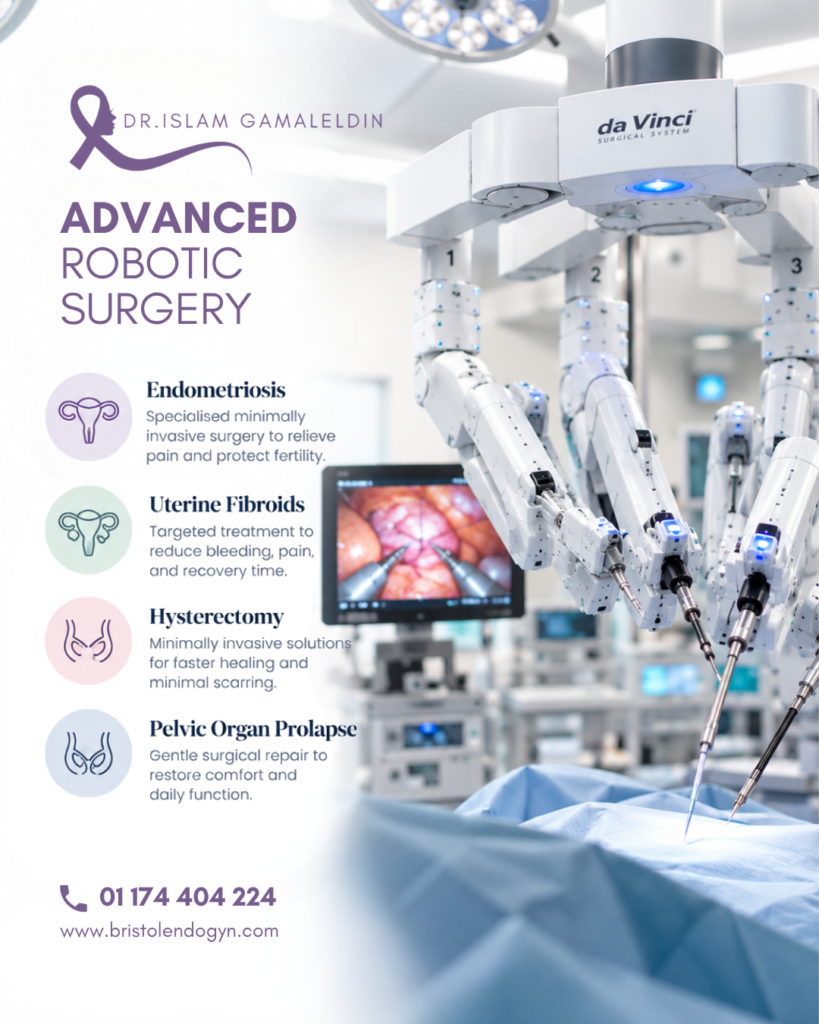
Advances in minimally invasive surgery have transformed the treatment of many gynaecological conditions.
Robotic gynaecological surgery allows the surgeon to perform selected complex procedures through small incisions using highly precise instruments, enhanced visualisation and advanced surgical technology.
For appropriately selected patients, robotic-assisted surgery may be considered for conditions including endometriosis, uterine fibroids, hysterectomy and pelvic organ prolapse.
The important point is that the robot does not perform the operation independently. The surgeon remains in control throughout the procedure.
What Is Robotic Gynaecological Surgery?
Robotic-assisted surgery is a form of minimally invasive, or keyhole, surgery.
Instead of making a large abdominal incision, the surgeon operates through several small incisions using a camera and specialised surgical instruments.
With systems such as the da Vinci surgical platform, the surgeon sits at a dedicated console and controls the robotic instruments in real time.
The technology can provide enhanced three-dimensional visualisation and instruments capable of highly controlled movements within the pelvis.
However, robotic technology is a surgical tool. The experience, judgement and expertise of the surgeon remain fundamental.
What Are the Potential Benefits of Robotic Surgery?
When clinically appropriate, a minimally invasive robotic approach may offer several potential advantages compared with traditional open surgery.
These can include smaller incisions, reduced blood loss, less postoperative discomfort, shorter hospital stays and a quicker return to normal activities.
However, outcomes vary according to the procedure, the complexity of the condition and the individual patient.
Robotic surgery is therefore not automatically the best option for every patient. The surgical approach should always be selected according to individual circumstances.
Robotic Surgery for Endometriosis
Endometriosis occurs when tissue similar to the lining of the uterus grows outside the uterus.
It can cause symptoms including severe period pain, chronic pelvic pain, pain during intercourse, bowel or bladder symptoms and fertility difficulties.
For some patients with complex or deep endometriosis, surgery may be considered when symptoms are significant or when other treatment approaches have not provided adequate relief.
Robotic-assisted surgery can provide enhanced visualisation and precise instrument control during selected complex pelvic procedures.
The aim of surgery should be based on the patient’s individual disease pattern, symptoms, fertility wishes and treatment priorities.
Robotic Surgery for Uterine Fibroids
Uterine fibroids are benign growths that develop within or around the uterus.
Depending on their size and location, fibroids can be associated with:
- Heavy menstrual bleeding
- Pelvic pressure or discomfort
- Abdominal swelling
- Urinary symptoms
- Fertility difficulties
For selected patients, robotic-assisted myomectomy may be used to remove fibroids while preserving the uterus.
The appropriate treatment depends on the number, size and position of the fibroids, as well as symptoms and future fertility plans.
Robotic-Assisted Hysterectomy
A hysterectomy is an operation to remove the uterus and may be recommended for several benign gynaecological conditions when other treatments are unsuitable or have not been effective.
These can include fibroids, adenomyosis, heavy menstrual bleeding, chronic pelvic pain and, in selected circumstances, endometriosis.
A robotic-assisted hysterectomy can allow the procedure to be performed through small abdominal incisions rather than a larger open incision.
Whether robotic surgery, conventional laparoscopy or another approach is most appropriate depends on the patient’s diagnosis and individual clinical circumstances.
Robotic Surgery for Pelvic Organ Prolapse
Pelvic organ prolapse occurs when one or more pelvic organs descend from their normal position.
Symptoms can include pelvic pressure, vaginal bulging, urinary problems and discomfort during everyday activities.
Some prolapse procedures can be performed using minimally invasive laparoscopic or robotic techniques.
As with other forms of robotic gynaecological surgery, treatment should be personalised according to the type of prolapse, severity of symptoms, previous surgery and individual patient priorities.
Robotic Surgery vs Laparoscopic Surgery
Both robotic and conventional laparoscopic surgery are minimally invasive techniques.
Traditional laparoscopy uses long instruments controlled directly by the surgeon. In robotic-assisted surgery, the surgeon controls articulated instruments from a console.
Robotic technology can be particularly useful in selected technically complex operations because of its instrument articulation, stable visualisation and ergonomics.
However, robotic surgery is not necessarily superior to laparoscopy for every procedure or every patient.
The most important consideration is choosing the surgical technique that is appropriate for the patient’s condition and that can be performed safely by an experienced surgeon.
Is the Robot Performing the Operation?
No.
This is an important misconception about robotic surgery.
The robotic surgical system does not operate autonomously and does not make surgical decisions.
Every movement of the instruments is controlled by the surgeon. The technology translates the surgeon’s movements into precise movements of the instruments inside the patient’s body.
It is therefore more accurate to describe the procedure as robotic-assisted surgery.
What Happens Before Robotic Gynaecological Surgery?
Before considering surgery, a detailed assessment is required.
This may include reviewing symptoms, previous treatments, medical history, fertility priorities and previous operations.
Depending on the condition, specialist ultrasound, MRI or other investigations may also be recommended.
This assessment helps determine whether surgery is appropriate and, importantly, whether a robotic, laparoscopic or alternative approach is most suitable.
Recovery After Robotic Surgery
Recovery varies considerably depending on the operation performed and the complexity of surgery.
Because robotic procedures are minimally invasive, some patients may experience a shorter hospital stay and faster recovery than after comparable open surgery.
However, patients should receive personalised advice regarding physical activity, driving, work, exercise and sexual activity following their procedure.
Recovery should never be rushed simply because an operation was performed robotically.
Choosing the Right Surgical Approach
Advanced technology is valuable, but technology alone does not determine the quality of surgical care.
The decision to operate — and the choice between robotic, laparoscopic, hysteroscopic or open surgery — should be based on the patient’s diagnosis, anatomy, symptoms, previous treatments and personal priorities.
For complex conditions such as endometriosis, the surgeon’s experience in managing the disease is particularly important.
The goal is not simply to use the newest technology. It is to select the most appropriate treatment for each individual patient.
Robotic Gynaecological Surgery in Bristol
Dr Islam Gamaleldin provides specialist gynaecological care in Bristol, with expertise in endometriosis and advanced minimally invasive pelvic surgery.
Assessment and treatment are personalised according to each patient’s symptoms, diagnosis and priorities, with laparoscopic or robotic-assisted surgery considered when clinically appropriate.
Dr Islam Gamaleldin
Consultant Gynaecologist & Endometriosis Specialist
📍 Spire Bristol Hospital
The Glen, Redland Hill, Redland
Bristol BS6 6UT
📞 0117 440 4224
🌐 bristolendogyn.com
Frequently Asked Questions
Is robotic gynaecological surgery minimally invasive?
Yes. Robotic-assisted surgery is a form of minimally invasive surgery performed through small incisions using a camera and specialised instruments controlled by the surgeon.
Can robotic surgery be used for endometriosis?
It can be used for selected endometriosis procedures, particularly where complex pelvic surgery is required. The most appropriate surgical technique depends on the location and extent of disease and the individual patient’s circumstances.
Can fibroids be removed robotically?
Selected patients may be suitable for robotic-assisted myomectomy, which removes fibroids while preserving the uterus. Suitability depends on factors including the number, size and location of the fibroids.
Can a hysterectomy be performed robotically?
Yes. Some hysterectomies can be performed using robotic-assisted minimally invasive surgery. However, robotic surgery is not necessary or appropriate for every hysterectomy.
Does the da Vinci robot perform the surgery itself?
No. The surgeon controls the instruments throughout the operation. The robotic system does not independently perform the procedure or make surgical decisions.
Is robotic surgery better than laparoscopic surgery?
Not necessarily. Both are established minimally invasive approaches. The best technique depends on the procedure, its complexity, the patient’s circumstances and the surgeon’s expertise.