
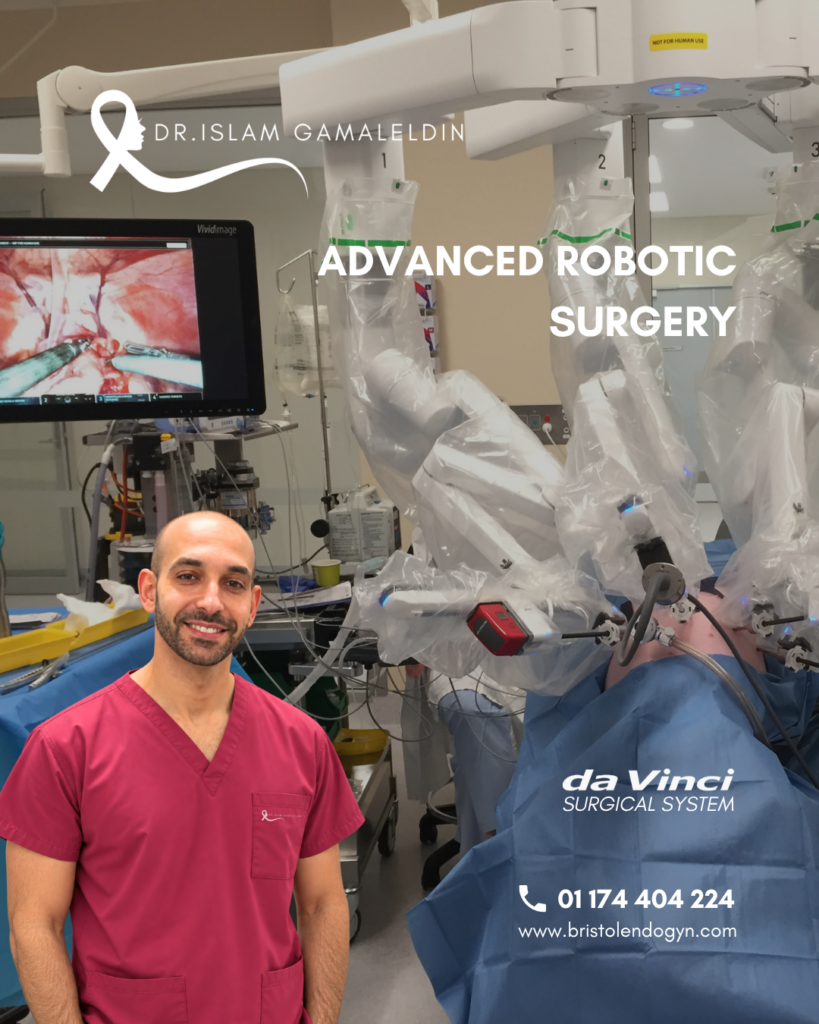
Advances in minimally invasive surgery have transformed the way many gynaecological conditions can be treated.
Robotic gynaecological surgery allows the surgeon to perform selected procedures through small incisions while using sophisticated instruments, magnified three-dimensional vision and highly controlled movements.
For patients with conditions such as complex endometriosis, fibroids or other benign gynaecological conditions, robotic-assisted surgery may be considered when it offers an appropriate surgical approach.
Importantly, the robot does not perform the operation independently. The surgeon remains in control throughout the procedure.
What Is Robotic Gynaecological Surgery?
Robotic-assisted surgery is a form of minimally invasive, or keyhole, surgery.
During the operation, the surgeon works from a dedicated console and controls specialised instruments positioned inside the patient through small incisions.
The robotic system translates the surgeon’s hand movements into precise movements of the surgical instruments.
Modern robotic platforms can provide enhanced visualisation and instrument articulation, which can be particularly useful when operating in anatomically complex areas of the pelvis.
Is the Robot Performing the Surgery?
No.
This is an important distinction for patients considering robotic surgery.
A robotic surgical system is not an autonomous surgeon. It does not make independent decisions or perform the procedure by itself.
The surgeon controls the instruments throughout the operation.
Robotic technology is therefore best understood as an advanced surgical platform designed to assist the surgeon in performing minimally invasive procedures.
What Are the Potential Advantages of Robotic Surgery?
Depending on the procedure and individual patient, robotic-assisted surgery can offer several technical advantages.
These may include enhanced three-dimensional visualisation of the surgical field, highly articulated instruments, precise movement and improved access to difficult areas of the pelvis.
Because robotic surgery is performed using a minimally invasive approach, selected patients may also experience advantages associated with keyhole surgery compared with traditional open surgery.
However, robotic surgery is not automatically the best approach for every patient or every procedure.
The decision should be based on the condition being treated, previous surgery, anatomy, disease complexity and the experience of the surgical team.
Robotic Surgery for Endometriosis
Endometriosis can sometimes involve complex areas of the pelvis and may affect structures close to the bowel, bladder, ureters and pelvic sidewalls.
Surgery for complex endometriosis therefore requires careful assessment, planning and appropriate surgical expertise.
In selected cases, robotic-assisted surgery can provide enhanced visualisation and instrument dexterity when performing minimally invasive surgery within these anatomically challenging areas.
The objective is not simply to use advanced technology. The priority is to select the surgical approach that is most appropriate for the individual patient and the pattern of disease.
Robotic Surgery for Other Gynaecological Conditions
Robotic-assisted techniques may also be considered for selected patients undergoing surgery for other benign gynaecological conditions.
Depending on the individual case, these can include:
- Fibroids and selected myomectomy procedures
- Hysterectomy
- Complex pelvic surgery
- Selected ovarian conditions
- Surgery involving pelvic adhesions
- Other benign gynaecological conditions requiring minimally invasive surgery
A specialist consultation is necessary to determine whether robotic, conventional laparoscopic or another treatment approach is most appropriate.
Robotic Surgery vs Laparoscopic Surgery
Both robotic and conventional laparoscopic surgery are minimally invasive techniques.
Traditional laparoscopy uses long instruments that the surgeon operates directly through small abdominal incisions.
In robotic-assisted surgery, the surgeon controls articulated robotic instruments from a console.
Robotic technology can provide additional instrument flexibility and three-dimensional magnified visualisation. Conventional laparoscopy, however, remains highly effective for many gynaecological procedures.
One technique should therefore not automatically be considered superior to the other.
The most appropriate surgical approach depends on the patient, the condition and the complexity of the planned procedure.
What Happens Before Robotic Gynaecological Surgery?
Careful assessment is an essential part of surgical planning.
This typically begins with a detailed consultation to understand your symptoms, previous treatments, medical and surgical history, fertility priorities and treatment goals.
Depending on your condition, further investigations may include specialist gynaecological ultrasound or MRI.
For complex endometriosis, imaging can be particularly important in helping to understand the location and extent of disease before surgery.
Where necessary, multidisciplinary input may also form part of the treatment plan.
Recovery After Robotic Surgery
Recovery varies according to the procedure performed and the individual patient.
Because robotic surgery uses a minimally invasive approach, the incisions are generally smaller than those required for traditional open abdominal surgery.
However, robotic surgery is still surgery.
Recovery time depends on factors including the complexity and duration of the operation, the condition being treated, whether other organs are involved and the patient’s general health.
Your surgeon should explain the expected recovery, postoperative restrictions and follow-up plan before your procedure.
Choosing the Right Surgical Approach
Advanced technology is valuable, but technology alone does not determine the quality of surgical care.
The most important question is not simply:
“Can this operation be performed robotically?”
It is:
“Which approach is most appropriate for my individual condition?”
Treatment planning should consider your symptoms, diagnosis, previous treatments, fertility wishes and personal priorities alongside the potential benefits and limitations of each surgical option.
Robotic Gynaecological Surgery in Bristol
Dr Islam Gamaleldin provides specialist care for women with endometriosis and other benign gynaecological conditions, with expertise in advanced minimally invasive laparoscopic and robotic pelvic surgery.
Patients considering surgery can receive an individual assessment to determine the most appropriate treatment strategy based on their symptoms, diagnosis and personal priorities.
For some patients, robotic-assisted surgery may form part of that treatment. For others, conventional laparoscopy, medical management or another approach may be more appropriate.
The focus remains on specialist assessment, appropriate surgical planning and personalised care.
Book a Specialist Consultation
If you have been diagnosed with endometriosis, fibroids or another gynaecological condition and would like to discuss your treatment or surgical options:
Dr Islam Gamaleldin
Consultant Gynaecologist & Endometriosis Specialist
📍 Spire Bristol Hospital
The Glen, Redland Hill, Redland
Bristol BS6 6UT, United Kingdom
📞 0117 440 4224
Frequently Asked Questions About Robotic Gynaecological Surgery
Is robotic surgery performed by a robot?
No. The surgeon remains in control of the operation and controls the robotic instruments throughout the procedure.
Is robotic surgery minimally invasive?
Yes. Robotic-assisted gynaecological surgery is a form of minimally invasive surgery that generally uses several small incisions rather than a large abdominal incision.
Can robotic surgery be used for endometriosis?
It may be used for selected endometriosis procedures, particularly where the surgeon considers robotic assistance appropriate for the location and complexity of the disease.
Is robotic surgery better than laparoscopy?
Not necessarily. Both are established minimally invasive approaches. The most appropriate technique depends on the procedure, the patient’s circumstances and the surgeon’s assessment.
How long does recovery take?
Recovery varies significantly according to the type and complexity of surgery. Your surgical team should provide personalised advice regarding recovery, activity, work and follow-up.
Is everyone suitable for robotic surgery?
No. Suitability needs to be assessed individually. Some patients may be better suited to conventional laparoscopy, another surgical approach or non-surgical management.